Marketing · Research · Strategy
When everyone has AI: where marketing advantage goes
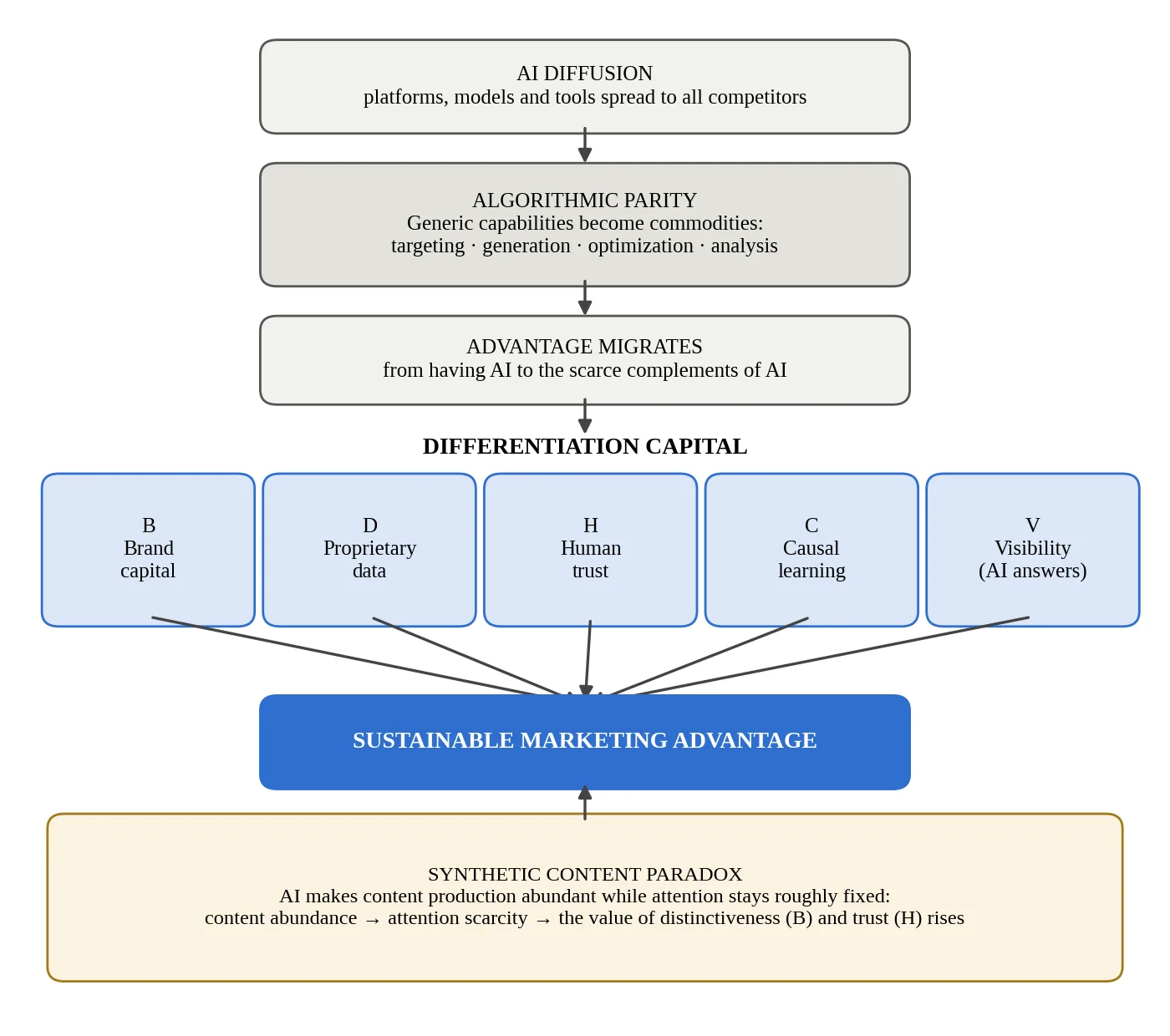
If every competitor rents the same AI from the same platforms, advantage has to come from somewhere else. My new working paper names the condition, Algorithmic Parity, and the five assets that stay scarce, Differentiation Capital.
Adithya Reddy · · Updated · 12 min read
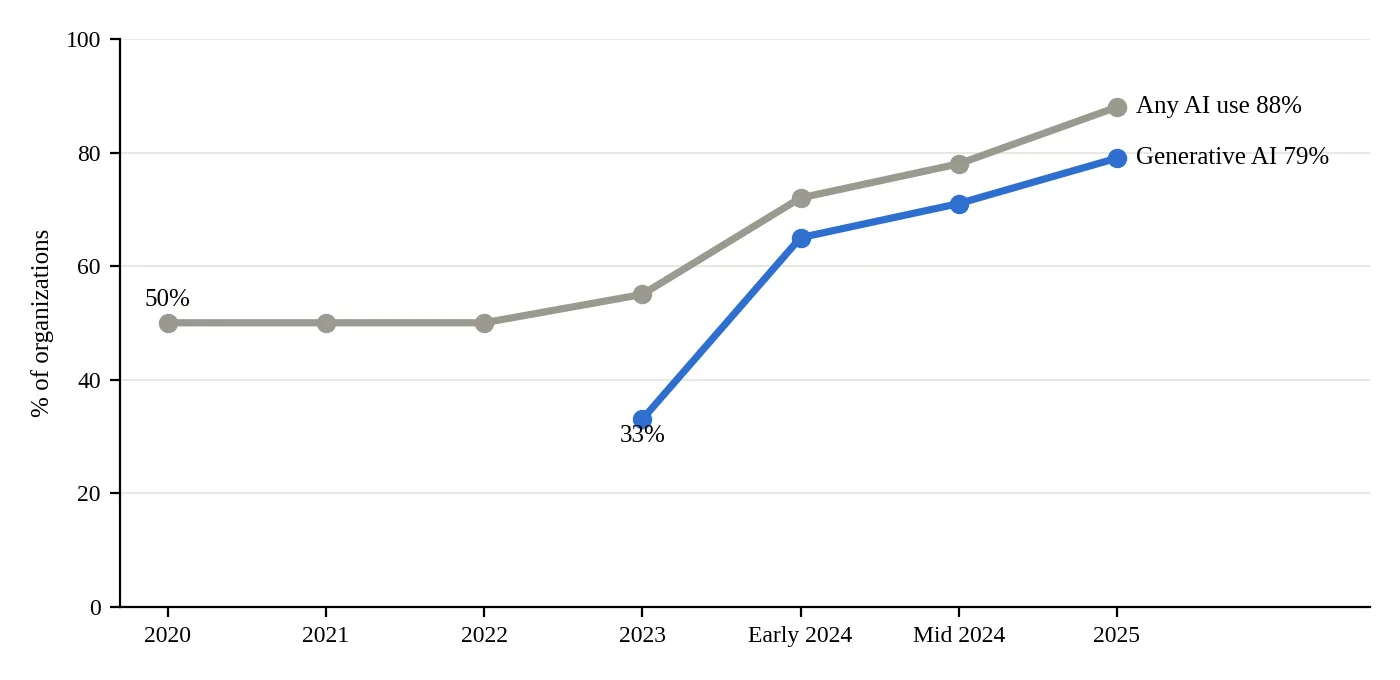
In 2020, about half of organizations used AI in at least one business function. By 2025 it was 88 percent, and generative AI went from 33 percent to 79 percent in two years. Meta says its end-to-end AI ad tools passed a USD 60 billion annual run rate, and that more than 4 million advertisers use at least one of its generative tools.
AI is no longer scarce. That raises a question I couldn't stop thinking about: if every competitor has the same intelligence, where does a marketing advantage come from?
This post is the plain-language version of my working paper, When Everyone Has AI: A Theory of Marketing Advantage Under Algorithmic Parity. It is now on SSRN (Abstract ID 7575263), or you can download the full paper (PDF).
The puzzle
Strategy theory says a resource gives lasting advantage only if it is valuable, rare and hard to imitate (Barney, 1991). AI for targeting, creative, optimization and analysis is valuable. But it is increasingly available to everyone, often through the same platforms.
The question has a precedent. Carr (2003) argued that IT becomes infrastructure as it spreads and confers no lasting advantage. Brynjolfsson and Hitt (2003) answered that returns to IT depend on complementary organizational assets. Generative AI revives that debate with two new features:
- It commoditizes not just analysis and optimization but content production, the part of marketing long treated as the creative, human work.
- Much of the AI sits inside platforms that control the auction, the audience and the measurement.
Algorithmic Parity
Three things to note about the definition. It concerns access to capability, not use or skill, because firms can differ in how well they use a shared tool. It is a property of a market at a time, so it may hold for bidding long before it holds for creative work. And it is a matter of degree.
Four mechanisms push markets toward parity:
- Diffusion. Adoption follows an S-curve, and generative AI is easy to try and not very complex, which shortened the early-adopter phase.
- Platform embedding. Google's Performance Max and Meta's Advantage+ bundle targeting, bidding and creative selection for every advertiser.
- Model convergence. Commercial models and image generators are available by subscription to any firm.
- Delivery through incumbents. AI mostly arrives as features inside platforms marketers already use, not as standalone products.
Parity of access still coexists with big differences in depth. Only 7 percent of organizations report AI fully scaled (McKinsey, 2025), and 70 percent of CMOs say their processes are not mature enough to scale it (Gartner, 2026). That gap is where the rest of the theory lives.
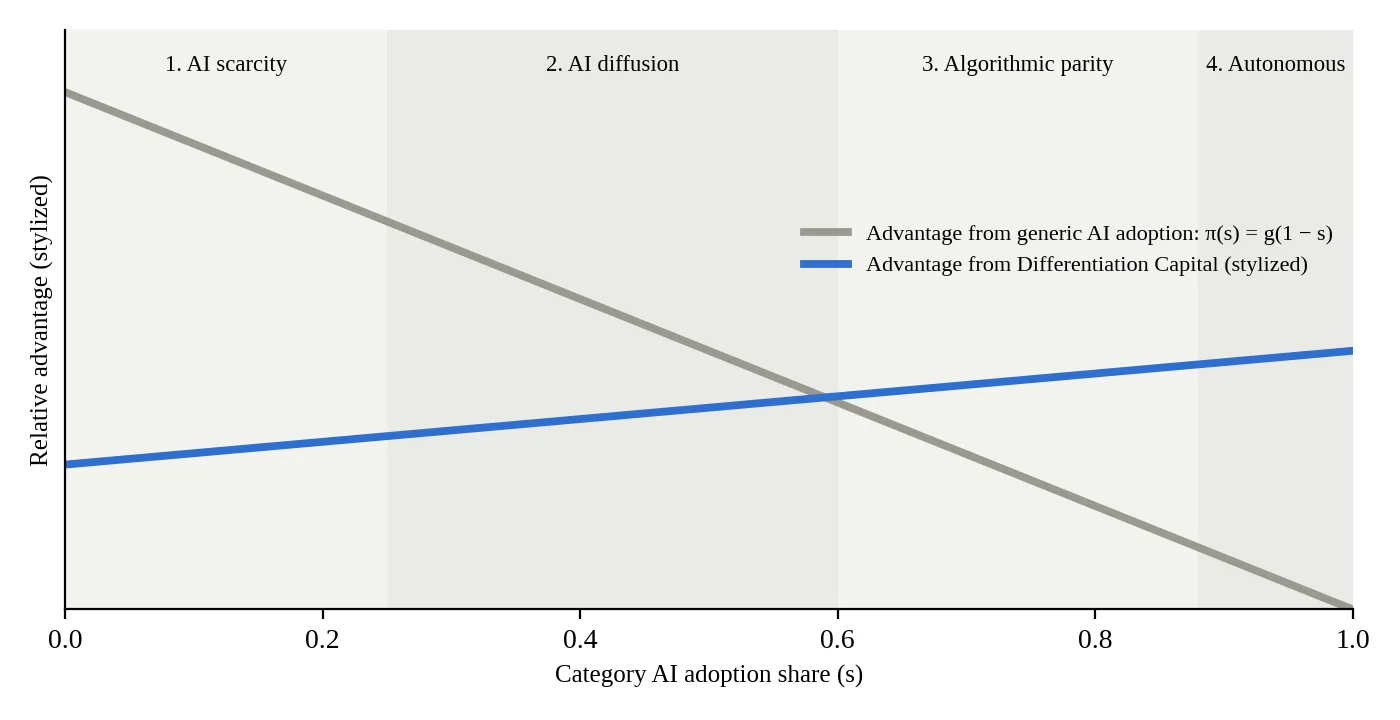
Early on, adopters beat non-adopters. As adoption spreads, the adopter premium falls and the sources of advantage move to complements.
Differentiation Capital
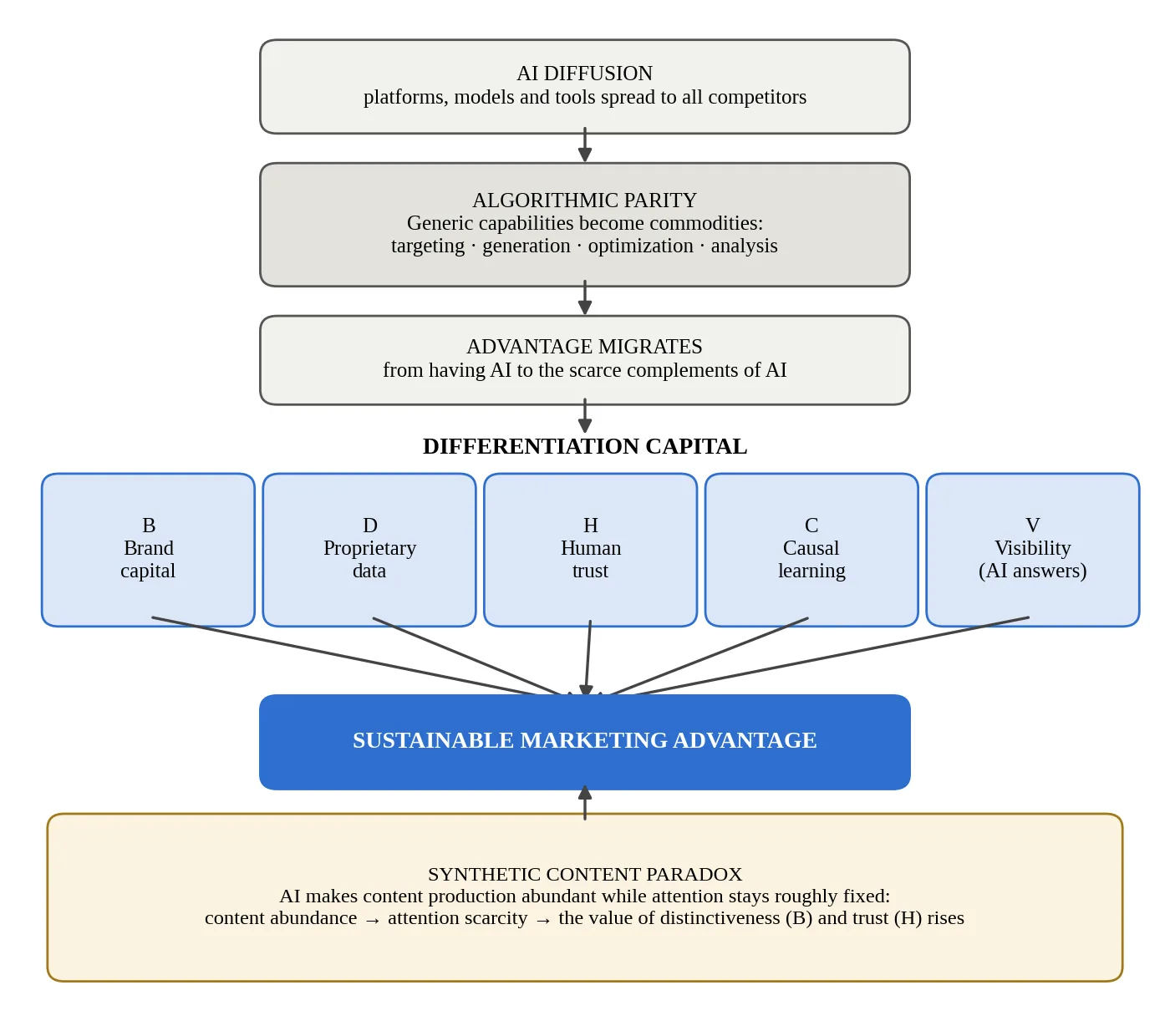
Differentiation Capital is the set of resources that stay scarce when AI is widely and equally available, and that raise the return to AI when combined with it. It has five parts:
| Capital | What it is | Why it stays scarce |
|---|---|---|
| Brand (B) | Distinctive assets, positioning, reputation and memory structures | Built over years of consistent exposure; can't be licensed with a model |
| Proprietary data (D) | First-party customer records, purchase histories, organizational knowledge | Owned by the firm; data-protection law (GDPR, India's DPDP Act) limits transfer and reuse |
| Human trust (H) | Human credibility, creators, employees, real-world evidence | Rests on relationships and proof a model can't generate |
| Causal learning (C) | Experimentation, incrementality measurement, learning faster than rivals | Needs process, data access and discipline, not only tools |
| Visibility (V) | Discoverability in search, AI answers and agent-mediated discovery | Depends on machine-readable authority and citable proprietary information |
"Capital" is used in a broad sense. Brand and data resemble accumulated stocks. Causal learning and visibility are closer to capabilities. What they share is that each is firm-specific, persists across campaigns, and raises the return to AI. The theory draws on the resource-based view, brand equity and dynamic capabilities, and adds two items specific to the AI setting: causal learning, because platform automation makes independent measurement rare, and visibility, because discovery is shifting toward generated answers.
The Synthetic Content Paradox
Generative AI makes content cheap. Klarna reported that AI cut its image development cycle from six weeks to seven days and produced more than 1,000 images in a quarter. Coca-Cola's 2025 holiday ad reportedly used AI to generate more than 70,000 video clips in about 30 days.
But human attention doesn't scale with production. Simon (1971) observed that a wealth of information creates a poverty of attention.
What follows from it:
- Production is no longer the bottleneck. The scarce input is an idea or identity that is recognizably the brand's.
- Quantity is not distinctiveness. Kantar's analysis of Coca-Cola's AI ads concluded that effective creative principles stay the same whether or not AI is used.
- Distinctive assets gain value. When similar synthetic content fills feeds, a recognizable brand asset helps an ad get noticed and remembered.
- Trust becomes a filter. Consumer comfort with brand AI fell from 57 to 46 percent between Q3 2023 and Q3 2024, and 59 percent named loss of the human touch as the main downside.
This is a claim about direction. It does not say AI content is ineffective. It says that once content abundance is common knowledge among competitors, the return to additional undifferentiated content falls.
The model, in one paragraph
Let firm 's marketing performance be
where is the AI capability available to the firm and is its Differentiation Capital, a complementary composite , so a missing component limits the whole. Relative to the market average (subscript ):
Under algorithmic parity for every firm, so the first term vanishes:
When everyone has similar intelligence, performance differences come from differences in Differentiation Capital. Adoption dynamics are modelled as an adopter premium that shrinks as the adoption share rises: . This is a deliberately simple, stylized device for organizing predictions, not an estimate.
Eight falsifiable propositions
Each proposition says what would prove it wrong.
| # | Proposition | Falsified if |
|---|---|---|
| P1 | AI diffusion: the marginal advantage from generic AI adoption declines as category adoption rises | The adopter premium is flat or rising as adoption rises |
| P2 | Proprietary complement: the return to AI rises when combined with proprietary data and knowledge | No interaction between AI use and proprietary inputs |
| P3 | Creative parity: generative AI raises creative quantity faster than creative distinctiveness | Distinctiveness rises in proportion to output |
| P4 | Human salience: human involvement raises trust more when the interaction has high identity, emotional or credibility demands | Human involvement has equal effect on low- and high-demand tasks |
| P5 | Platform dependency: more reliance on platform-controlled AI raises execution efficiency but lowers observability and strategic control | Observability does not fall as automation rises |
| P6 | Measurement advantage: under parity, superior causal measurement creates more durable advantage than superior platform optimization | Optimization skill predicts durable performance better than measurement skill |
| P7 | Brand capital: the value of distinctive brand assets rises as generative content supply rises | The value of distinctive assets doesn't rise with supply |
| P8 | AI visibility: as discovery shifts to generated answers and agents, visibility depends on machine-readable authority and citable proprietary information | Citation in AI answers is unrelated to authority and structured content |
What the evidence says so far
I audited published secondary evidence against each proposition. This is not a test. Most sources are vendor surveys or platform statements, so "consistent" means the direction is compatible and no contrary evidence was found, not that the proposition is supported.
The uncomfortable part: P1, P3 and P7 are the three that carry the core of the theory, and nobody has directly tested them. A few of the data points that fit:
- P2. AI-mature organizations allocate 21.3% of budgets to AI versus 15.3% on average (Gartner, 2026). Correlational only.
- P5. Practitioners describe lower visibility as automation improves, and Meta's incremental attribution feature reached a multi-billion-dollar run rate in seven months.
- P6. Only 41% of marketers can prove AI ROI (Konabayev, 2026).
- P8. AI Overviews cut click-through by about 58% (Ahrefs, 2026), while search-purpose AI crawling rose from 1.32% to 8.26% (Cloudflare Radar, via TechnologyChecker, 2026).
Five studies to test it
The studies below are designed but not yet run. The plan is to pre-register hypotheses, measures and analysis on a public platform before collecting data, and to report results whether or not they support the theory.
- Study 0: a Differentiation Capital Index. Develop and validate scales for B, D, H, C and V (interviews, expert content validity, exploratory and confirmatory factor analysis on two samples of about 300 marketers). It also tests whether the capitals behave as complements, as the model assumes, or as an additive index.
- Study 1: does the AI advantage decline with category adoption? (P1) A panel of advertisers with staggered adoption of AI features, estimated with event-study and difference-in-differences methods.
- Study 2: human, AI and Human+AI creative (P3, P4, P7). An online experiment with about 3,000 participants across four product categories, varying who made the creative, whether AI use is disclosed, and brand familiarity.
- Study 3: do proprietary inputs improve AI advertising? (P2) A randomized campaign experiment where the same AI tools run with generic inputs only, or with the advertiser's brand knowledge and first-party data.
- Study 4: does independent measurement change conclusions? (P5, P6) Compare platform-reported return on ad spend with holdout or geo-lift incrementality estimates.
The paper also proposes two metrics for a world where content is abundant:
Here is brand distinctiveness (for example, correct brand attribution without the logo), is creative production cost, is the incremental brand or revenue effect of a creative set, and is its total cost including review labor and media. They let a firm compare 10,000 AI-generated ads with 100 memorable ones on outcomes, not volume.
What managers can do now
If the theory is right, invest in AI to reach parity and in Differentiation Capital to exceed it.
| Capital | What to build | First actions |
|---|---|---|
| Brand (B) | A small set of distinctive, consistently used assets and a documented brand voice | Audit distinctive assets; encode brand rules for AI tools; keep flagship creative human-led |
| Data (D) | Consented first-party data and a knowledge base AI tools can use | Map data under DPDP and GDPR duties; feed platforms first-party signals; build an internal brand knowledge base |
| Human trust (H) | Visible human craft, real evidence and honest disclosure | Keep real people and proof where audiences expect them; design AI disclosure; review every published AI output |
| Causal learning (C) | Routine incrementality testing | Hold out audience or geography for major campaigns; reconcile platform-reported results to sales data quarterly; compare AI and human creative in the same test |
| Visibility (V) | Presence in AI answers | Allow search-purpose crawlers; publish structured, citable content and original research; track citations and brand-search lift |
Most firms aren't organized for this yet: 70 percent of CMOs say their processes are immature for scaling AI, 56 percent say they lack budget, and budgets stayed flat at 7.7 to 7.8 percent of revenue (Gartner, 2026). The paper's conclusion for managers is that this has to be funded by reallocation, and its appendix maps more than twenty marketing tactics to the capitals they build.
Where this goes next
- Platforms. If P5 holds, advertisers will demand observability: incrementality tools, independent measurement access and clearer reporting.
- Regulators. The paper predicts that disclosure and data rules raise the value of D and H, because they restrict substitutes. (Legal descriptions in the paper are research context, not legal advice, and should be rechecked.)
- Agentic competition. If agents optimize campaigns continuously, parity in execution deepens and human advantage moves further upstream: to strategy, identity, proprietary knowledge, governance and trust. The paper sketches three scenarios, embedded-and-governed, platform-capture and trust-correction, and the signposts to watch for each.
Limitations
I'd rather state them than have a reviewer find them:
- No original data, and the propositions are untested.
- Secondary and vendor sources. Many statistics came through republishers; platform figures are management statements. Before any journal version they should be replaced with original reports.
- A stylized model with constant elasticities and a composite index.
- No validated scales yet for the five capitals. That's Study 0.
- Alternative explanations. Advantage under parity could also come from price, distribution, product quality and operations.
- Boundary conditions. Parity may not hold for firms without data, skills or budget, and some AI capabilities may stay proprietary.
- Time boundary. Evidence runs to early October 2026, and regulation and platform products change quickly.
Conclusion
AI changes the economic location of marketing advantage. When execution, analysis and optimization are available to everyone, advantage moves to what AI doesn't supply: distinctive brands, proprietary data, human trust, the ability to learn causally, and visibility to machines. At the same time, content abundance makes attention scarcer, which raises the value of being distinctive.
If the studies support the theory, the question for marketers is no longer whether to adopt AI, but where advantage resides once everyone has it.
Frequently asked questions
What is Algorithmic Parity?
Algorithmic Parity is the condition in which competing firms have access to functionally similar AI for targeting, bidding, content generation, optimization and measurement, so differences in performance are not mainly explained by differences in access to AI.
What is Differentiation Capital?
Differentiation Capital is the set of five firm-specific resources that stay scarce when AI is widely available and raise the return to AI when combined with it: brand capital, proprietary data capital, human trust capital, causal learning capital and visibility capital.
What is the Synthetic Content Paradox?
The cheaper content becomes to produce, the harder meaningful attention becomes to obtain, so value shifts from production to distinctiveness.
Does the paper prove the theory?
No. It is a theory and research-design paper with no new experimental data. It audits published secondary evidence, finds it consistent in direction with all eight propositions, and specifies five pre-registered studies to test them. Those studies have not been conducted yet.
Where can I read the full paper?
You can download the PDF. It is published as a working paper on SSRN (Abstract ID 7575263).